OK, I am waaay behind Serena on starting the Purgatorio, because I had to slog through a 71-page introduction. But I have finished! There are things to say:
Well, really just one thing: I don't know what I'm doing with my life. STOP, this is relevant, I swear. I don't know what I want to do and I don't know how to figure out what I want to do, and I hate it. Because I don't have any goals. I'm good at achieving goals when I have them, but I don't know how to get one, and I can't just assign myself one at random so I'll feel good about having an accomplishment. That'd be like cheating at solitaire or something.
Oh, but I miss achieving goals.
Anyway, so the difference between Purgatory and Hell?
The people in Purgatory have a goal! All their punishments seem light because they've got something they're working toward and they know they'll get through it. Whereas the punishments in hell are both neverending and frustratingly circular. Oh, and everyone in Purgatory is always happily focused on God, while everyone in Hell is self-obsessed.*
So thanks a lot, Dante. Like I wasn't worried enough about drifting through my post-college years, now you have to come along and be like "Hey, that's exactly what Hell is like! Ha!"
In other news, even though this translation is definitely inferior to the Hollander, it'll be nice to read something in terza rima**. Oh, and I am excited for the middle of the story, which is where great epics are made or broken. The second bit of a great trilogy is always best (with a few exceptions), and always most difficult to pull off.
Nora Ephron is wise: "[This story] has a happy ending, but that’s because I insist on happy endings; I would insist on happy beginnings too, but that’s not necessary because all beginnings are intrinsically happy, in my opinion. What about middles, you may ask. Middles are a problem. Middles are perhaps the major problem of contemporary life."***
*Fourth circle: Bloggers.
**And Sayers actually sticks to the terza rima hardcore: rather than ABA CDC she's gone with ABA BCB, if that makes sense.
***It's from Heartburn, which is NOT on the Iditarod but is not without merit either.
Tuesday, February 24, 2009

Monday, February 23, 2009
from worse to bad?
After that uplifting start to the week, it's back to our regularly scheduled litany of depression.
Today's contenders for the title of Cranky Curmudgeon Ruining My Morning:
1. Thomas H. Benton at the Chronicle, who has written two different pieces about why you should NEVER EVER GO TO GRAD SCHOOL GOD WHAT ARE YOU CRAZY?! The man really seems hell-bent on crushing my fragile hopes and dreams.
2. Tedra Osell at IHE thinks that Benton hasn't done enough to send me into a crisis of anxiety and self-doubt, so she adds her two cents.
Is this one of those situations where I just have to ignore everything everyone tells me?
Neither Benton nor Osell addresses the person who is currently working in the media and thinking about applying to graduate school. These days, going from the media to the academy is only going from the fire into the frying pan, no?
Today's contenders for the title of Cranky Curmudgeon Ruining My Morning:
1. Thomas H. Benton at the Chronicle, who has written two different pieces about why you should NEVER EVER GO TO GRAD SCHOOL GOD WHAT ARE YOU CRAZY?! The man really seems hell-bent on crushing my fragile hopes and dreams.
2. Tedra Osell at IHE thinks that Benton hasn't done enough to send me into a crisis of anxiety and self-doubt, so she adds her two cents.
Is this one of those situations where I just have to ignore everything everyone tells me?
Neither Benton nor Osell addresses the person who is currently working in the media and thinking about applying to graduate school. These days, going from the media to the academy is only going from the fire into the frying pan, no?
the most relevant photos yet!
Normally we post photos with only the faintest claim to relevance, if any. This is because blogs with no pictures are a bit boring, especially to those of us with very, very short attention spans.
Today, however, it is my pleasure to bring you a most timely set of photographs.
 I take my studies ever so seriously. I am as inspired and humbled by Dante as Dante is by Virgil. Or... something.
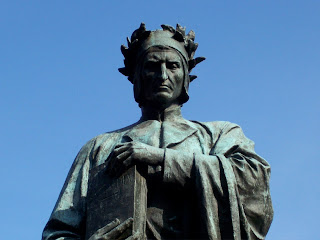 Note to self: Dante is off the list of Historical Figures with Whom I'd Like to Have a Beer.
 I told Fiona we were at Madame Tussauds.*
------------------------------------------------------------------------------
*Madame Tussauds is breaking this man's heart. It's shocking.
Today, however, it is my pleasure to bring you a most timely set of photographs.
 I take my studies ever so seriously. I am as inspired and humbled by Dante as Dante is by Virgil. Or... something.
 Note to self: Dante is off the list of Historical Figures with Whom I'd Like to Have a Beer.
 I told Fiona we were at Madame Tussauds.*
------------------------------------------------------------------------------
*Madame Tussauds is breaking this man's heart. It's shocking.
Friday, February 20, 2009
Post It: Dante, If You're Going to Make Rules ...
Speaking of Cato the Younger being in Purgatory (I'm still in the introduction to my version of the Purgatorio, but more on that later when I am not swamped), anyone else think it's odd that Cato is there at all? Since he, you know, COMMITTED SUICIDE?
Just sayin', Dante. Isn't there a circle of hell for inconsistent poets?
Just sayin', Dante. Isn't there a circle of hell for inconsistent poets?
Romeo and Juliet it ain't...
Normally I would leave the business of anecdotes to Fiona, since it's really more her domain than mine. But since we've only read translations so far, I can't get into the language as I would otherwise be inclined to do; I can remark on my fondness (or lack thereof) for the work of a certain translator, and guess at the extent to which the translation mirrors the original -- but as I have, you know, small Tuscan and less Greek, I'm reluctant to go too deeply into word choice or sentence structure.
And so! From the opening of the Purgatorio, I bring you an anecdote.
For whatever crazy Dante reason, Cato of Utica is charged with guarding the shores of Purgatory. At first he thinks Virgil and Dante are escapees from hell, so Virgil explains their situation, concluding,
To which Cato replies rather brusquely:
I'm resisting a Brady Bunch joke here because, to be honest, I never watched that show, so it'd seem like too cheap a shot. Instead, let's find out who Marcia was. Ciardi has the goods:
I sort of expect Dante to romanticize things, but it sounds like Ciardi might be airbrushing this story a little himself. According to Wikipedia, that bastion of accuracy,
----------------------------------------------------
*Chaucer's "Marcia Catoun." Modern Philology, Vol. 30, No. 4 (May, 1933), pp. 361-364. The University of Chicago Press.
And so! From the opening of the Purgatorio, I bring you an anecdote.
For whatever crazy Dante reason, Cato of Utica is charged with guarding the shores of Purgatory. At first he thinks Virgil and Dante are escapees from hell, so Virgil explains their situation, concluding,
"We do not break the Laws: this man lives yet,
and I am of that Round not ruled by Minos,
with your own Marcia, whose chaste eyes seem set
in endless prayers to you. O blessed breast
to hold her yet your own! for love of her
grant us permission to pursue our quest
across your seven kingdoms. When I go
back to her side I shall bear thanks of you
if you will let me speak your name below." (Canto I, ll. 76-84)
To which Cato replies rather brusquely:
"Marcia was so pleasing in my eyes
there on the other side," he answered then
"that all she asked, I did. Now that she lies
beyond the evil river, no word or prayer
of hers may move me. Such was the Decree
pronounced upon us when I rose from there.
But if, as you have said, a Heavenly Dame
orders your way, there is no need to flatter:
you need but ask it of me in her name." (85-93)
I'm resisting a Brady Bunch joke here because, to be honest, I never watched that show, so it'd seem like too cheap a shot. Instead, let's find out who Marcia was. Ciardi has the goods:
The story of Marcia and of Cato is an extraordinary one. She was the daughter of the consul Philippus and became Cato's second wife, bearing his three children. In 56 B.C., in an unusual transaction approved by her father, Cato released her in order that she might marry his friend Hortensius. (Hence line 87: "that all she asked I did.") After the death of Hortensius, Cato took her back.
In Il Convivio, IV, 28, Dante presents the newly widowed Marcia praying to be taken back in order that she may die the wife of Cato, and that it may be said of her that she was not cast forth from his love. Dante treats that return as an allegory of the return of the strayed soul to God (that it may die "married" to God, and that God's love for it be manifest to all time). Virgil describes Marcia as still praying to Cato. (p. 190, note to l. 78)
I sort of expect Dante to romanticize things, but it sounds like Ciardi might be airbrushing this story a little himself. According to Wikipedia, that bastion of accuracy,
Hortensius was an admirer and friend of Cato’s, and he was eager to be more closely related to Cato and his family. ...[A]n alliance with Cato seems to be the chief reason for Hortensius, nearing 60 years old, to request to be married to Cato’s daughter Porcia, who was only about 20 years old at the time. However, because Porcia was already married to M. Calpurnius Bibulus and the age difference was so great, Cato refused to give his consent. Hortensius immediately suggested that he marry Marcia instead because she had already borne Cato his heirs. Due to Hortensius' ardor, Cato acquiesced, but only on the condition that Marcia's father, L. Marcius Philippus, approve as well. With Phillipus' consent obtained, Cato divorced Marcia, thereby placing her under her father's charge. Hortensius promptly married Marcia, and she bore him an heir. After Hortensius' death in 50 BC, she also inherited much of Hortensius' considerable wealth.
At the outbreak of the civil war in 49, Marcia and her children moved back into Cato’s household. Plutarch asserts that Cato remarried Marcia after Hortensius's death, whereas Appian's histories relate that Cato merely reestablished her in his own household.
Well that's... significantly less romantic than I'd hoped. Facts are always ruining Dante's great stories. (From the way Ciardi put it, I was sort of imagining that Marcia'd married Cato out of, whatever, family reasons, duty, but then cultivated this burning and reciprocal passion for his good friend Hortensius, and Cato, let's say, pulled a Francisco d'Anconia -- oh, yeah, I went there -- and stepped aside out of love for the two of them, then remarried Marcia after Hortensius' death so she wouldn't be lonely/poor. Yeah... no.)
Additional exciting Marcia facts:
--Marie Hamilton* suggests that "during the Middle Ages... Marcia was proverbial for virtue" (362), possibly because in Lucan's Pharsalia "on the occasion of her return to Cato she asks permission to share his anxieties and sorrows" (364).
--This, then, would be why she gets a mention in Chaucer's The Legend of Good Women:
Penalopee, and Marcia Catoun--Way, way more about Marcia as the figure of an obedient woman here. This article is actually super-interesting, but this post is already sort of out of control.
Mak of your wyfhod no comparisoun.
----------------------------------------------------
*Chaucer's "Marcia Catoun." Modern Philology, Vol. 30, No. 4 (May, 1933), pp. 361-364. The University of Chicago Press.
Thursday, February 19, 2009
anxieties
It might be that I'd already read the Odyssey and the Oresteia, and that Beowulf came across as such a clear precursor of Tolkien that it wasn't exactly new.
I like to lay the blame at the feet of Robert and Jean Hollander, who translated my Inferno.
Whatever the reason, the Inferno is the first book on the Iditarod that made me sit up and take notice. It felt like something I could study and read for years and always stay interested, and it made me see why all the medievalists I know scoff at just about everyone who isn't a medievalist. You know that contented sigh that comes after you finish a great book, and you see WHY it's great and you feel a tiny connection to the whole of Western history and everyone else who has read and loved and seen the significance of that particular book? I got that. I've never read anything like this -- it's so complex and gorgeous. The only thing it ever made me think of was Donne's poetry. But those are tiny complicated bites, and this is this monster of a book. Imagine what it must be like to sit down and try to do a new translation.
Not to be all middle-school book review ("This was the best book I've ever read!!!"), but go read it, if you haven't.
Oh, and the best part? I don't want to read the Purgatorio and Paradiso, because I have a different translation of those, and I don't want to hate them for not being the Hollander. But I have a feeling I might.
This is Dante, right? This has been around for centuries, no way it's totally ruined even by a dunce of a translator trying too hard to stick to terza rima when all we care about is the suffering and the stars.
Right?
I like to lay the blame at the feet of Robert and Jean Hollander, who translated my Inferno.
Whatever the reason, the Inferno is the first book on the Iditarod that made me sit up and take notice. It felt like something I could study and read for years and always stay interested, and it made me see why all the medievalists I know scoff at just about everyone who isn't a medievalist. You know that contented sigh that comes after you finish a great book, and you see WHY it's great and you feel a tiny connection to the whole of Western history and everyone else who has read and loved and seen the significance of that particular book? I got that. I've never read anything like this -- it's so complex and gorgeous. The only thing it ever made me think of was Donne's poetry. But those are tiny complicated bites, and this is this monster of a book. Imagine what it must be like to sit down and try to do a new translation.
Not to be all middle-school book review ("This was the best book I've ever read!!!"), but go read it, if you haven't.
Oh, and the best part? I don't want to read the Purgatorio and Paradiso, because I have a different translation of those, and I don't want to hate them for not being the Hollander. But I have a feeling I might.
This is Dante, right? This has been around for centuries, no way it's totally ruined even by a dunce of a translator trying too hard to stick to terza rima when all we care about is the suffering and the stars.
Right?
Tuesday, February 17, 2009
Post-It: No way, Dante. No. Way.
I finally finished the Inferno. Toward the end there I was pretty sure Dante made it that long so that the reader could experience what it is like actually to be in Hell. Then I took a look at the Purgatorio and the Paradiso and I decided that Dante was just a cruel and spiteful man.
I'm thinking of slipping a lotus into Fiona's drink and telling her we already finished the entire Comedia and we can move on with our lives.
I'm thinking of slipping a lotus into Fiona's drink and telling her we already finished the entire Comedia and we can move on with our lives.
Post-it: A Brilliant Idea
So a local theatre company is currently running a sort of dance theatre version of the Divine Comedy, and I was scheduled to go see it. Let's see how oblique I can be about this: One aspect of my job enables me to see plays for free pretty much whenever I want to. In this particular instance, I had planned to go with another person who has the same job to see Divine Comedy, using his spare free ticket instead of getting one of my own. But then he didn't end up going and therefore I missed the allotted "night of free tickets," and while I could still go, it feels weird to actually pay to see a play.
I might still go.
Anyway, a friend of mine (go read her blog!) did see it. And she said that, while it was intriguing, the actor playing Virgil sounded very similar to Will Arnett.
Meaning she spent the entire production wondering what the Divine Comedy would be like with Gob Bluth leading Dante around. On a Segway. Muttering about his "illusions."
I might still go.
Anyway, a friend of mine (go read her blog!) did see it. And she said that, while it was intriguing, the actor playing Virgil sounded very similar to Will Arnett.
Meaning she spent the entire production wondering what the Divine Comedy would be like with Gob Bluth leading Dante around. On a Segway. Muttering about his "illusions."
Monday, February 16, 2009
excuses, excuses
It's not clear what Fiona's excuse is. As for me, I have been taking a break from Dante to read my uncle's book, because the guilt of not having done so was really getting to me. The book is basically a super-liberal hippie fantasy of JFK surviving Dallas and using the political capital from doing so to remake America into the country my uncle would like it to be. Imagine MLK as Secretary of State, RFK as VP, the end of conflicts with Cuba and the USSR, etc.
My uncle being who he is, he gets very into the political nitty gritty, so the book doesn't have much of a plot beyond, you know, "Here's how this could be done, and here's how THIS could be done, and...". It's basically a blueprint for fixing America starting in 1963. Luckily, he's a good enough writer that I don't find this as irritating as I'd expect; the book is actually rather gripping. (I knew that I enjoyed his writing, but it's been a while.)
And hey, if I ever run into David Ignatius at a party, we'll have something to talk about.
I've also been distracted by my new computer. There's really no way to rationalize the dent this sucker put in my savings account, but I tried anyway. I'm on my computer a lot, including doing a significant part of my job from home (because I edit the next day's articles every night), and using Dave's old desktop was making me miserable (it dies, inexplicably, two or three times a day). My old iBook lasted a long time (I had a 2004 model that I purchased used in 2005, and it survived into the early part of 2009), and I have every hope that my new MacBook will last me well into graduate school.
Anyway, I'm almost done with Unafraid, so I'll be back to regular blogging shortly. And maybe more frequently, now that using a computer isn't such a damned trial.
My uncle being who he is, he gets very into the political nitty gritty, so the book doesn't have much of a plot beyond, you know, "Here's how this could be done, and here's how THIS could be done, and...". It's basically a blueprint for fixing America starting in 1963. Luckily, he's a good enough writer that I don't find this as irritating as I'd expect; the book is actually rather gripping. (I knew that I enjoyed his writing, but it's been a while.)
And hey, if I ever run into David Ignatius at a party, we'll have something to talk about.
I've also been distracted by my new computer. There's really no way to rationalize the dent this sucker put in my savings account, but I tried anyway. I'm on my computer a lot, including doing a significant part of my job from home (because I edit the next day's articles every night), and using Dave's old desktop was making me miserable (it dies, inexplicably, two or three times a day). My old iBook lasted a long time (I had a 2004 model that I purchased used in 2005, and it survived into the early part of 2009), and I have every hope that my new MacBook will last me well into graduate school.
Anyway, I'm almost done with Unafraid, so I'll be back to regular blogging shortly. And maybe more frequently, now that using a computer isn't such a damned trial.
Wednesday, February 11, 2009
Dante was kind of a vindictive little dude
Since we are both ladies who work in the general vicinity of the news, it's nice to sometimes be able to bring you, our devoted and loving readers, something that's topical ... AND somehow related to the Iditarod.
Ta-da! The New York Times took time out from its busy CEO-defending schedule to publish this article, which you should read because it's cool, but which I will summarize here for those of you who are afraid of links: Ahem. The Catholic Church is bringing back indulgences! It's not quite a return to the medieval, because they're not allowed to sell them per se. Rather, donations to charity can earn indulgences for church members.
For those of you rolling your eyes and opening up a Wikipedia tab, here's how it works. Catholics confess their sins, but they still have to do time in Purgatory to make up for all those sins before they can get into Heaven. Indulgences are a thing the church can give you that will reduce your time in purgatory. They come in two varieties: partial, which gets you out of some of your time, and plenary, which gets you straight into Heaven until you commit some other sin. Oh, and you can buy them for dead people too. Well, not buy them. Anyway, apparently a lot of modern Catholics have never heard of them, because THEY HAVE NEVER READ THE INFERNO, APPARENTLY. The church did away with indulgences in the '60s, but they definitely had them in Dante's time. In fact, there is a whole bolgia in the 8th circle of hell for priests who sold them. The practice is called simony ("the more you know!"), and the guys who committed it are in these sort of hellish baptismal fonts, upside down, and when other simoniacs they go in the same fonts and eventually the souls get sort of hammered down into the rock of hell.*
Oh, one thing to know about indulgences: if you go to hell, they don't help you at all.
On another note, Dante was the most creative, sick dude who ever lived. Seriously, he could be a villain in one of those horror movies where the crazed psychokiller thinks of ever more horrible, tortuous ways to do away with his victims.
Actually, that would be kind of a sweet movie.
*Heh. Reality show name?
Ta-da! The New York Times took time out from its busy CEO-defending schedule to publish this article, which you should read because it's cool, but which I will summarize here for those of you who are afraid of links: Ahem. The Catholic Church is bringing back indulgences! It's not quite a return to the medieval, because they're not allowed to sell them per se. Rather, donations to charity can earn indulgences for church members.
For those of you rolling your eyes and opening up a Wikipedia tab, here's how it works. Catholics confess their sins, but they still have to do time in Purgatory to make up for all those sins before they can get into Heaven. Indulgences are a thing the church can give you that will reduce your time in purgatory. They come in two varieties: partial, which gets you out of some of your time, and plenary, which gets you straight into Heaven until you commit some other sin. Oh, and you can buy them for dead people too. Well, not buy them. Anyway, apparently a lot of modern Catholics have never heard of them, because THEY HAVE NEVER READ THE INFERNO, APPARENTLY. The church did away with indulgences in the '60s, but they definitely had them in Dante's time. In fact, there is a whole bolgia in the 8th circle of hell for priests who sold them. The practice is called simony ("the more you know!"), and the guys who committed it are in these sort of hellish baptismal fonts, upside down, and when other simoniacs they go in the same fonts and eventually the souls get sort of hammered down into the rock of hell.*
Oh, one thing to know about indulgences: if you go to hell, they don't help you at all.
On another note, Dante was the most creative, sick dude who ever lived. Seriously, he could be a villain in one of those horror movies where the crazed psychokiller thinks of ever more horrible, tortuous ways to do away with his victims.
Actually, that would be kind of a sweet movie.
*Heh. Reality show name?
Subscribe to:
Posts (Atom)


 Posts
Posts

